Removal and cancellation
Registering with the credit bureau or protesting is half the job; the other half is taking the record down at the right time. A debtor who paid and remains registered with the bureau is a legal liability — timely removal is the creditor's obligation, not a courtesy.
When to remove or cancel
- Debt paid — paid, remove. As soon as possible.
- Agreement accepted — a renegotiated debt should not remain registered as it was.
- Dispute upheld — if the debtor's challenge was accepted (wrong amount, nonexistent debt), the record falls along with the charge.
- Operational error — a record created for the wrong person or with the wrong amount: remove immediately and record the reason.
Removing a credit bureau registration
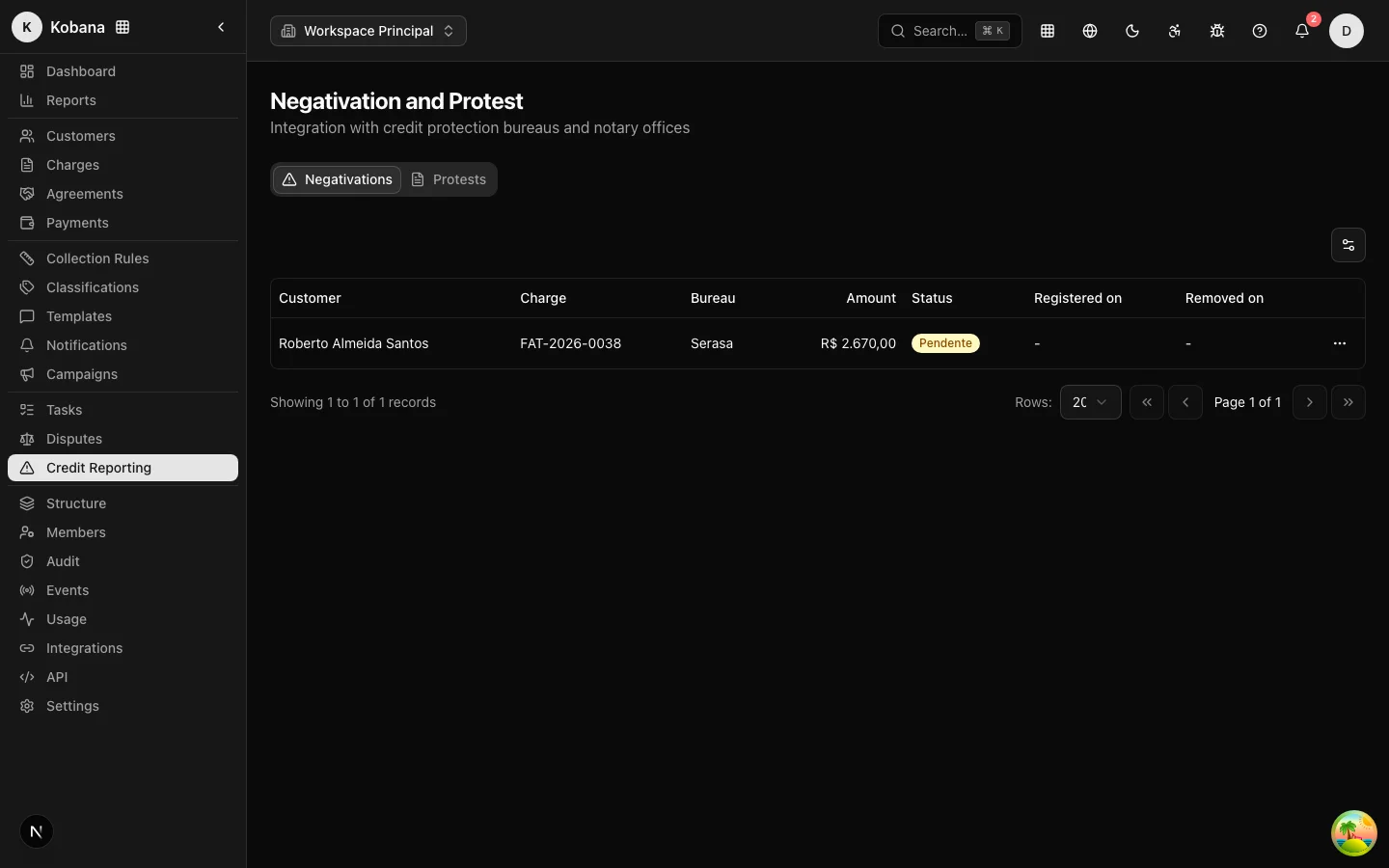
Only active registrations (active) can be removed — a record still pending should simply not be approved (and can be cancelled during review). The removal:
- Changes the status to
removed; - Records the removal date and the reason (
removalReason) — always provide one: "payment on May 12th", "agreement #123 accepted", "dispute upheld"; - Remains available in the history — the record does not disappear; what matters in an audit is proving that you removed it, and when.
The operation requires the cancel permission for negativations and is available on the record's screen and via the API (POST /api/v1/negativations/{id}/remove).
Cancelling a protest
The protest has more phases, and cancellation follows suit:
- Before submission (
pending) — simply do not approve; the receivable never reaches the notary office. - After submission (
sent/intimated) — cancel the protest: the status becomescancelledwith the cancellation date recorded. - Receivable paid at the notary office — the notary office receives the payment and the record moves to
paid, with date and fees. - Protest recorded (
protested) — cancellation at the notary office follows the office's own legal procedure; record the outcome in the system (status, dates and the office's response) to keep the trail faithful.
The operation requires the cancel permission for protests (POST /api/v1/protests/{id}/cancel).
Automation and reconciliation
The system pauses and interrupts sends automatically when the debt is paid — but the formal removal at the bureau/notary office involves the external body, so it surfaces to your team as an action to execute and confirm. Use the webhooks (negativation.*, protest.*) to integrate with the bureau/notary office or with your legal team, and periodically reconcile the Credit Bureau & Protest tab with the body's reports: an active record with a paid charge is the first thing an audit will look for.
:::caution Timing matters The damage from a wrongful credit bureau registration grows with the time it stays up. Treat post-payment removals with the same urgency as review tasks: the Tasks queue and the in-app notifications exist for that. :::