Dashboard
The dashboard is Dunning's home: the portfolio snapshot on top, the operational row in the middle, and the details below. Every card is clickable and leads to the corresponding filtered screen.
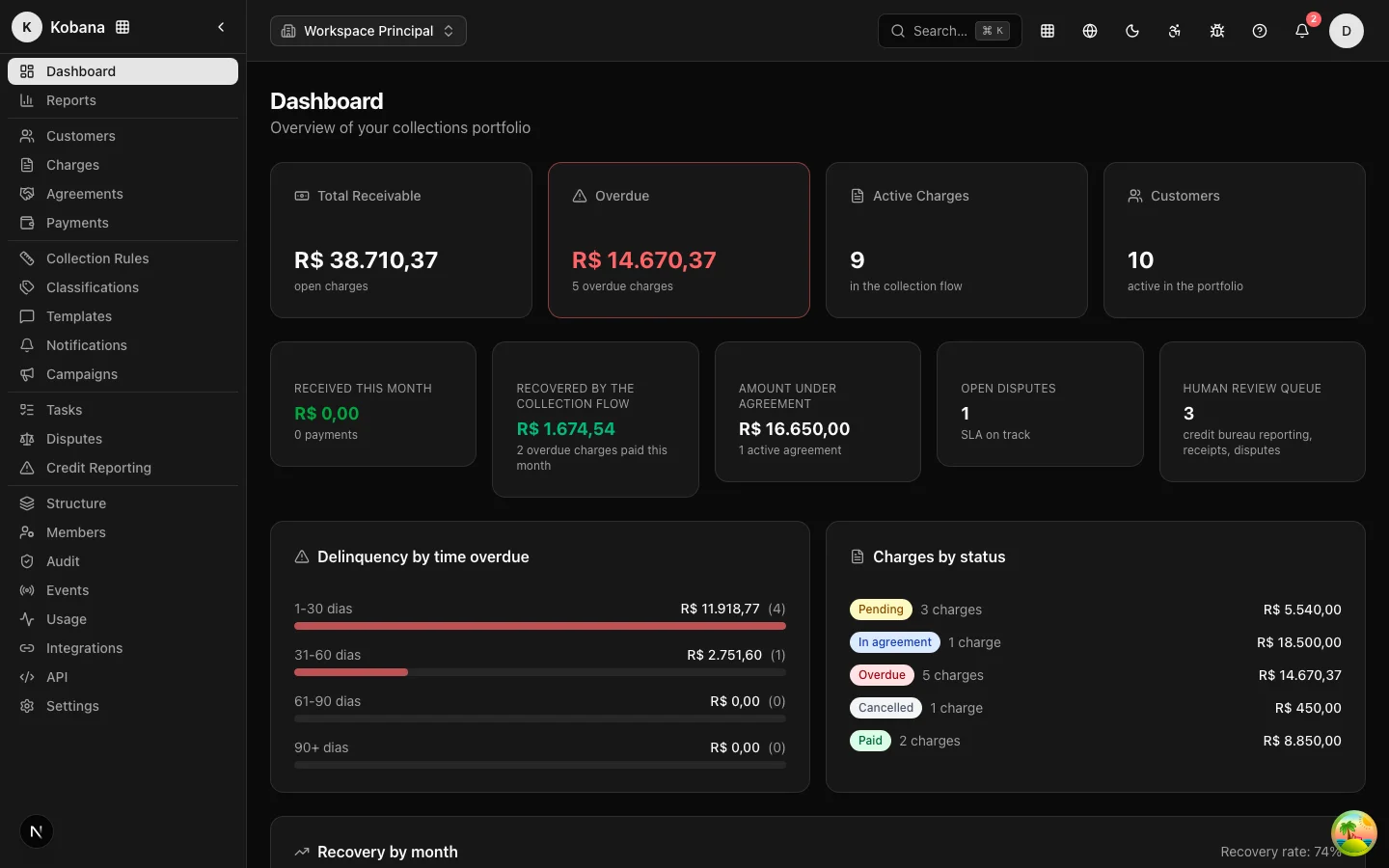
The portfolio snapshot (4 KPIs)
- Total Receivable — the combined amount of open charges.
- Overdue — the overdue amount, with the count of overdue charges. The card gets a red highlight when there is any delinquency; clicking it opens the charges list already filtered to overdue.
- Active Charges — how many charges are enrolled in a collection rule.
- Customers — the size of the active portfolio.
Each KPI shows the change against the previous month's close (arrow and percentage). One honest detail: when there is no comparison baseline (a new account, a zeroed previous month), the indicator is omitted instead of showing a meaningless "+100%".
The operational row (5 cards)
What turned into cash, what is negotiated, and what needs a person:
- Received this month — every payment that came in during the current month, with the count.
- Recovered by the rule — the slice that matters to collections: overdue charges paid this month. See Recovery for the methodology.
- Amount in agreement — the total negotiated in active agreements, with the count.
- Open disputes — how many challenges await a decision. If any has breached the SLA, the card highlights "N past SLA" in red; otherwise, it shows "SLA on track".
- Human review queue — pending tasks that require a person: credit bureau registration approval, proof-of-payment verification, disputes.
Delinquency by age (aging)
The bar chart that answers "how old is my delinquency", in four buckets: 1–30 days, 31–60 days, 61–90 days, and 90+ days — each with amount and charge count. Aged debt recovers less: if the mass is migrating toward the right-hand buckets, it is a sign to revisit the rule or move to negotiation.
Recovery trend
The bar chart that shows the amount recovered month by month (recent months), with the recovery rate in the card header — the fraction of the portfolio that has already returned to cash. It is the trend reading of the rule's money metric: if the bars are rising, the operation is recovering more over time. Powered by GET /api/v1/metrics/recovery; see Recovery for the methodology.
Charges by status
The distribution of the portfolio across the lifecycle statuses, with count and amount per status. The open statuses (Pending, Overdue, In agreement) come first; the final ones (Paid, Cancelled, Registered, Protested, Written off) follow.
Recent activity
The timeline of what happened last on the account: payments, notifications sent, agreements, and due dates. The events are honest — a due date shows dated on the day it fell due, a rule action shows as a rule action. It is the place to glance at in the morning and see whether the night brought payments or new delinquency.
Onboarding
While the account has not yet completed its initial setup, the top of the dashboard shows the Getting started card — the onboarding checklist, with the eight-step progress bar. It disappears on its own once everything is done, and the Hide button dismisses it before that (bring it back in Settings → Profile).