Integrator's guide
The path for the developer wiring an ERP, billing system, or gateway into Dunning: key, first call, first customer and charge, webhooks, and safe retries. This page is the route; the full contracts live in the API Reference (generated from the OpenAPI spec, never handwritten).
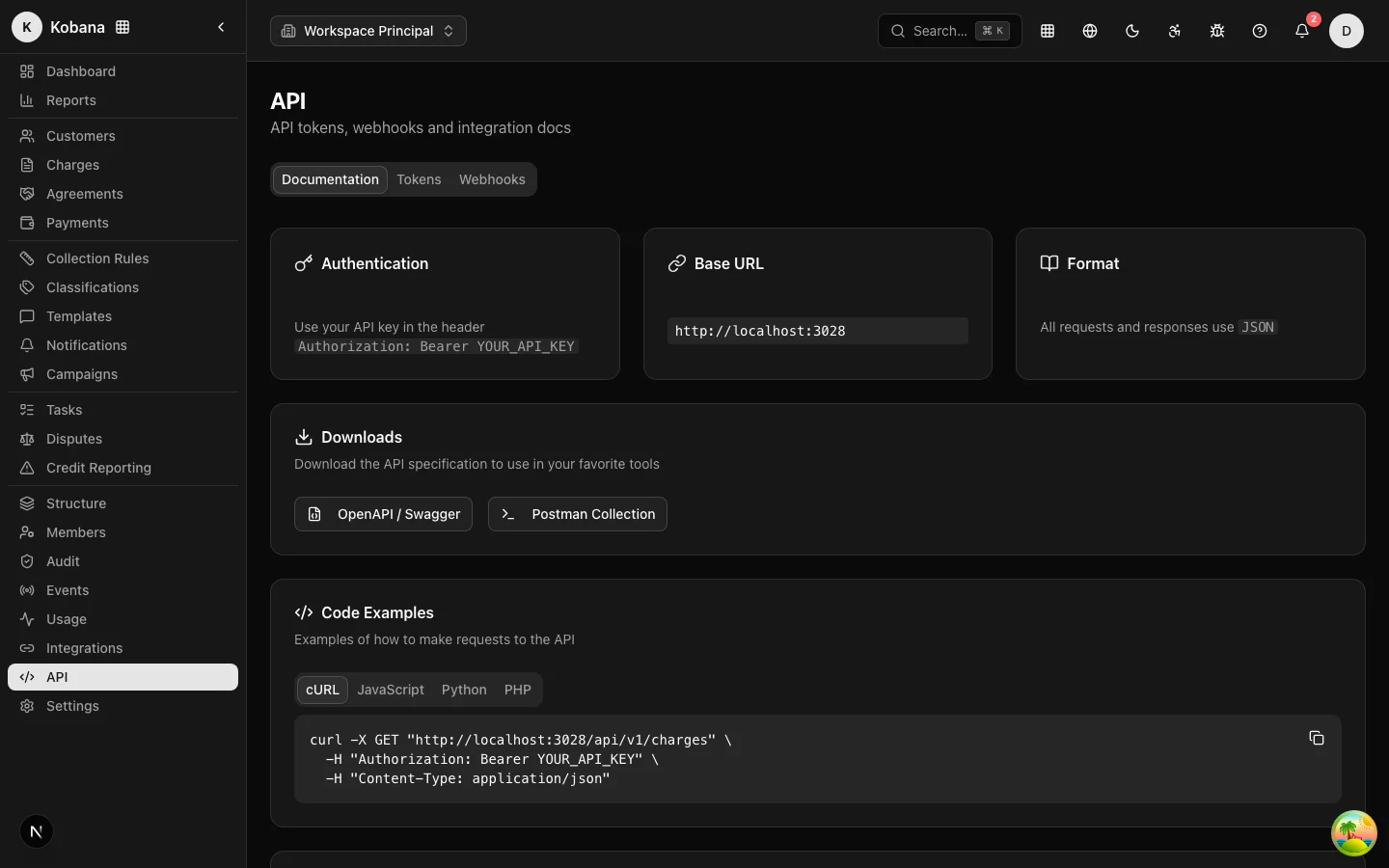
1. Create the API key
In Settings → Security (administrators only), create a key with:
- "Read and write" access level — it covers the entire business operation without exposing account administration. Administrative resources answer
403 API_KEY_FORBIDDENto any key: a leaked key cannot create administrators or other keys. - Expiration (30/90/365 days) with warning emails — periodic rotation limits the blast radius of a leak.
The token is shown only once; store it in a secrets vault. Details in API keys.
2. First call
Single public environment (the Sandbox is in preparation — to develop risk-free in the meantime, use an account without configured sending channels: sends are simulated):
curl -s "https://dunning.kobana.com.br/api/v1/people?per_page=5" \
  -H "Authorization: Bearer $DUNNING_API_KEY" \
  -H "User-Agent: My Integration <dev@mycompany.com>"
The User-Agent identifying your integration is mandatory and goes into the audit trail.
3. First customer and first charge
The minimum flow is POST /people followed by POST /charges — the complete, annotated payloads are in Practical examples. What matters to get right from day one:
externalIdon everything — the record's ID in your system. It is the deduplication key: a duplicate document answers409, and future imports update instead of duplicating.- Contacts on the customer — without email/phone, the rule has nowhere to send.
X-Idempotency-Keyon every mutation — see step 5.- Rule: pass
collectionRuleIdto pin the charge to a specific rule, or omit it and let automatic enrollment place the charge in the default rule. - Payment data (
pixEmv,paymentUrl,barcode) — the rule's messages go out already "payable".
4. Webhooks instead of polling
Register an endpoint (POST /webhook-endpoints or through the Webhooks screen) and receive business facts as JSON POSTs: charge.paid, charge.overdue, agreement.accepted, dispute.created... Rules of the game (overview):
- The URL must be
https://; the secret (whsec_) is shown once and signs every delivery via HMAC (X-Webhook-Signature) — always verify it. - Answer
2xxwithin 10 seconds: enqueue and process later. - Delivery is at-least-once: deduplicate by event +
data.id+timestamp. Failures enter the backoff retry cycle, with every attempt captured and manual redelivery available.
5. Idempotency and retries
Every mutation accepts X-Idempotency-Key (one UUID per business operation). If the network drops and you repeat the request with the same key within 24 hours, the API returns the original response (X-Idempotent-Replay: true) instead of duplicating the operation. Combine it with your retry policy: exponential backoff for 5xx, Retry-After for 429 RATE_LIMITED, and network timeouts treated as 5xx — idempotency resolves the "did it run or not?" ambiguity.
The house rules, in one table
| Topic | Summary | Reference |
|---|---|---|
| Authentication | Authorization: Bearer <key>; scopes from dunning.dashboard.* | Authentication |
| Format | JSON UTF-8; camelCase responses; ISO 8601 dates; monetary values as decimal strings | Introduction |
| Pagination | page/per_page/sort_by/sort_order; filters in snake_case | Pagination |
| Errors | { message, code, details? } envelope; branch on code | Errors and codes |
| Retention | Idempotency keys 24h; append-only audit trail | Data retention |
| Spec and Postman | OpenAPI 3.1 in PT/EN/ES + ready-made collection | Specifications · Postman |
Integrator's checklist
- "Read and write" key with expiration, stored in a vault.
User-AgentandX-Idempotency-Keyin production from the first deploy.- Webhook with signature verification and deduplication; monitored on the deliveries screen.
- Retry with backoff +
Retry-After; no tight loops. - Reconciliation by
externalIdin both directions (your system ↔ Dunning).