Charge sources
Every charge records where it came from in the source field (source). The source does not change how the rule treats the charge — it exists so you know the provenance of each receivable, can filter the portfolio by source, and can diagnose integration issues. It appears on the charge detail view and in the origem column of exports.
The possible sources
| Source | Code (API) | How the charge is born |
|---|---|---|
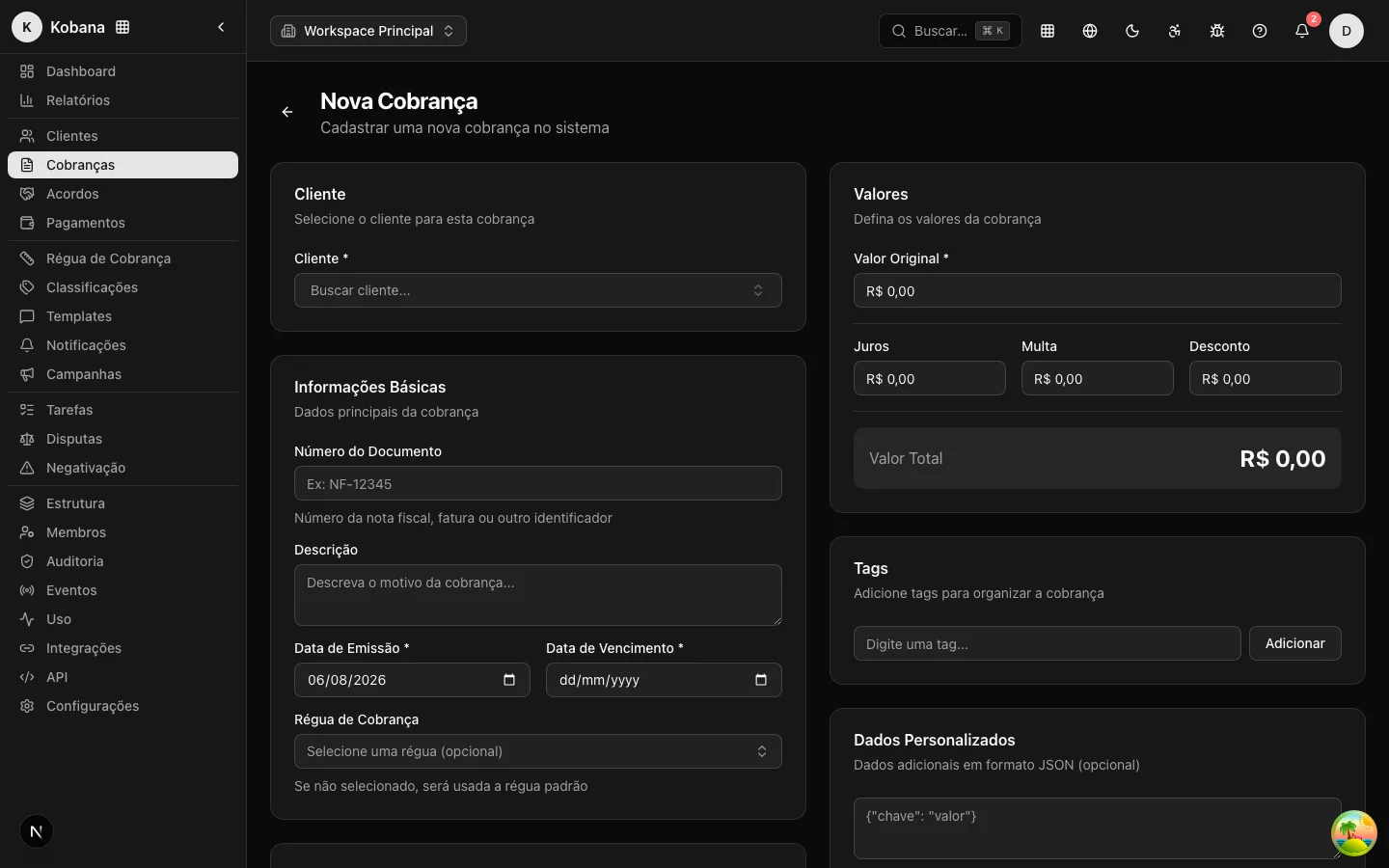
| Manual | manual | Created by the operator in the dashboard's New Charge form. |
| Spreadsheet | spreadsheet | Created by the CSV import on the Imports page. |
| API | api | Created through the v1 API by one of your systems (the default for in-house integrations). |
| ERP | erp | Created by synchronization with a connected ERP. |
| Kobana | kobana | Mirrored from the Kobana platform, when the account uses the gateway as its issuance and payment rail. |
What each source implies in practice
- Manual — useful for low volume or one-off cases. You control every field at creation, including payment details (boleto, Pix, link).
- Spreadsheet — the path for migrating the portfolio or for operations that live in Excel. The system deduplicates customers and validates row by row; the charge comes in with the correct status (Pending or Overdue) based on the due date.
- API — the source of truth becomes your system. Use the
external_idfield to correlate each charge with the originating record and receive webhooks back with that reference. - ERP — similar to the API, but fed by the connector's synchronization. The receivable is born and updated from the ERP.
- Kobana — in integrated mode, beyond issuance, payment confirmation arrives in real time via webhook, and settlement is automatic. It is the source with the least operational friction.
Integrated mode vs. standalone mode
Dunning works in both modes, and charge sources reflect that:
- With the Kobana gateway — charges with source
kobana, payment confirmed instantly, rule halted in real time. - Standalone — charges with source
manual,spreadsheet,api, orerp; the payment signal comes from a PSP, a CNAB file, or manual entry, each with its own confidence level (see Payment and settlement).
The two modes coexist in the same account: you can import the legacy portfolio by spreadsheet while new receivables arrive through the API.
Regardless of source, treatment is the same
Once created, the charge follows the same lifecycle, enrolls in the same rule (the default one, if none is specified), respects the same legal contact windows, and appears in the same metrics. The source is traceability, not privilege.